View Today's Active Threads (No Chit Chat/Chit Chat Only) / View New Posts (No Chit Chat/Chit Chat Only) / Mark All Boards Read / Chit Chat Board
I Love Lucy (Sitcoms Online) / I Love Lucy links and theme songs at Sitcoms Online / I Love Lucy Photo Gallery / The Lucy Show Message Board / Here's Lucy Message Board / Life with Lucy Message Board
 Buy I Love Lucy - The Complete Series on DVD |
 Buy I Love Lucy - Ultimate Season 1 on Blu-ray |
 Buy I Love Lucy - Ultimate Season 2 on Blu-ray |
 Buy I Love Lucy - Colorized Collection |
 |
|
|||||||
 |
|
|
Thread Tools | Search this Thread |
 02-26-2012, 01:55 PM
|
#1 |
|
Member
Forum 3000 Club Member
Join Date: Aug 04, 2009
Location: Memphis Tennessee
Posts: 3,073
|
 Television circa 1951
Last year was the 60th anniversary of "I Love Lucy" on CBS.
My question is, what was television like in 1951? How much of the nation actually watched this show in 1951? There were not network affiliates all over the country. How many people owned televisions in 1951? These early sets looked like small windows in a huge, heavy box of wires and an antenna. What is interesting about television is how people got turned on to it. I think it was a lot like the internet in the 1990's. Look how cool it is and people who would never buy a computer, buy a computer. So did people in 1951 go to their rich relatives house to watch I Love Lucy and Uncle Milty and decide that they needed a television of their own? It seems that this technology would have been available 5 to 10 years before but WWII got in the way which slowed the technology down. The "yes, we can do this" phase of the science of television seemed to came out in the early 1930's and even Nazi Germany had television before WWII in the 1930's. My father told me he saw the first television when he was in high school, so around 1949. This was in more or less rural Iowa near Cedar Rapids. I have read about the television stations in my hometown of Memphis and they did not come along until the mid 1950's into the run of "I Love Lucy". Early television fascinates me. |

|

|
|
02-27-2012, 09:24 PM
|
#2 | ||
|
Member
Senior Member

Join Date: Feb 22, 2009
Location: California
Posts: 2,246
|
Quote:
If you scroll down to page 11 under the heading "Compare Ratings," you can see that the last M*A*S*H had a 60.2 rating. That means 60.2% of homes with a television set were watching that show. The top-rated episode of I Love Lucy was the birth of Little Ricky. It had a rating of 71.7, meaning 71.7% of all households with a television set were watching I Love Lucy that night: http://www.hollywoodreporter.com/new...minated-222960 71.7 is a significantly larger rating than 60.2. The audience share that night was 92, meaning that 92% of television sets that were turned on were tuned into I Love Lucy. A 71.7% rating never happened before that night, and it's never ever happened again in all the years since. It's a record that's never been broken. Scroll down to about the middle of this web page -- http://en.wikipedia.org/wiki/Nielsen_ratings -- down to where it says "Top-Rated Programs," and you will see the ratings by season of the number one show each year. The average rating for I Love Lucy for the 1952-1953 season was 67.3. You can see that no show has come anywhere near that in the entire history of television. I Love Lucy was a hit from the start, debuting in the top ten. But within six months of its debut, it was a runaway hit, dominating all of television. According to the stats here -- http://www.tvhistory.tv/Annual_TV_Households_50-78.JPG -- there were 15,300,000 U.S. households with television sets in 1952. I think this means January 1952. Three months later, in April 1952, towards the end of the first season, 10,600,000 people watched I Love Lucy according to this: http://www.tvhistory.tv/1952%20QF.htm That means about two-thirds of all televisions were tuned in to I Love Lucy by the end of its first season. Quote:
|
||
|
|
|
|
02-28-2012, 05:58 AM
|
#3 |
|
anything good on?
Forum Regular

Join Date: Oct 18, 2005
Posts: 879
|
The first postwar TV sets offered for sale had either 7 or 10" screens, but development of larger tubes was very rapid. By 1951 many sets were being sold with 20" and larger screens. One infamous model that was marketed to TV fans with deep pockets (not to mention wide pocket doors) had a 30" screen.
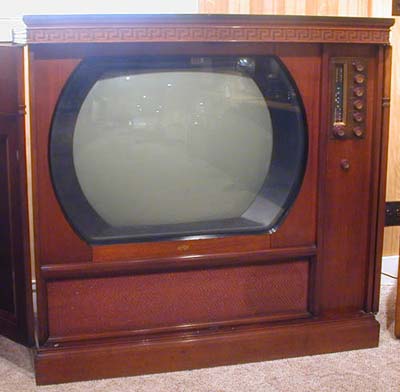 It's difficult to get a sense of scale, but that top is chest high on an adult male. The average viewer wouldn't have watched Lucy on a set that extravagant, but the sets being sold new in 1951 weren't by any description primitive, were available in screen sizes that ranged from small (if your needs so dictated) to very big, and more and more families got their first one every day. Muntz TV sets were specifically designed to be affordable to the common man, and no doubt many got their first glimpse of I Love Lucy on sets similar to this 1949 12" Muntz: |
|
|
|
|
02-28-2012, 11:06 AM
|
#4 |
|
Sentimental Fool
Forum Star

Join Date: Aug 22, 2009
Location: Near Notre Dame
Posts: 10,502
|
Over at IMDb, there is a message board for 1940s TV programming. It's great that some of that late '40s material still exists and can be enjoyed still.
The very early '50s already saw the beginning of The Adventures of Ozzie & Harriet on ABC-TV. There was a lot of radio-to-TV transition beginning to occur. |
|
__________________
In memory of lovely Erin Moran 1960-2017 ~ Missing you "For you are beautiful ~ And I have loved you dearly ~ More dearly than the spoken word can tell..." "What's the word?" (Paul Martin) ~~ "I don't want money for nothing." (Timmy Martin) -- Lassie ROCKS! WORD UP "It's just a dugout that my dad built... In case the reds decide to push the button down..." |
|
|
|
|
|
02-28-2012, 02:09 PM
|
#5 |
|
Member
Forum Regular
Join Date: Feb 10, 2012
Location: Chattanooga, TN
Posts: 863
|
Did the Beverly Hillbillies Giant Jack Rabbit episode come close to the ratings of I Love Lucy?
|
|
|
|
|
02-28-2012, 08:44 PM
|
#6 | |
|
Member
Senior Member
Join Date: Feb 22, 2009
Location: California
Posts: 2,246
|
Quote:
Number of Homes with Television Jan 1953: 20.4 million Jan 1964: 51.3 million Difference: 151% Number of Homes Watching: Lucy: 14.6 million Hillbillies: 21.8 million Difference: 48.7% Ratings Lucy: 71.7 Hillbillies: 42.4 Difference: -41% Ratings Share Lucy: 92 Hillbillies: 60 Difference: -35% |
|
|
|
|
|
02-29-2012, 10:39 AM
|
#7 |
|
Member
Forum 3000 Club Member
Join Date: Aug 04, 2009
Location: Memphis Tennessee
Posts: 3,073
|
I did not know that large televisions like that were available in 1951, but I am very sure that they were very expensive. Some of the old TV's that I have seen pictures of were big oak cabinets like old timey radios with tiny screens the size of not much more than dollar bills.
This is a fascinating Wiki article about television, which actually began broadcasting in the 1920's. http://en.wikipedia.org/wiki/History_of_television How much of the nation could watch "I Love Lucy" when it first came on in 1951? The largest cities in the nation had network affiliates, but what about the smaller cities and towns, in the Midwest or South? According to Wikipedia, my hometown's (Memphis Tennessee) network affiliate, WREG-TV did not broadcast until New Years day 1956, five years into I Love Lucy. Interestingly (and I just learned this), the NBC affiliate, WMC TV began in 1948 and was showing network content from all the networks at the time (NBC, CBS, DuMont), while ironically being an NBC network. So, in Memphis, Tennessee, I Love Lucy came on NBC (in that market) because there was no CBS. |
|
|
|
|
02-29-2012, 02:19 PM
|
#8 |
|
anything good on?
Forum Regular
Join Date: Oct 18, 2005
Posts: 879
|
The television of the 1920s and much of the 30s was totally experimental in nature and used mechanical means to accomplish the scanning of the picture. The only electronic element of early TV was the modulation of a light source to provide the details of the image. The various stations used a number of mutually incompatible low-res standards so that if you bought (or more likely built) a set for, say, the 45-line standard, you couldn't freely tune around to receive other stations broadcasting 48-line or 60-line pictures. None of those mechanical sets were of any use later when electronic TV was introduced.
Philo Farnsworth is credited as being the first to demonstrate an electronic TV system in his lab in the late 1920s. RCA conducted its first experiments with all-electronic TV in 1932 and continued to develop and perfect the technique until 1939 when, against the advisement of the FCC, it offered sets for sale to the general public with then state-of-the-art 441-line standard which RCA was broadcasting--but which did not have official recognition. The FCC would have preferred an even higher resolution service and part of the reason why the standard was ultimately officially fixed at 525-lines in 1941 was so that it wouldn't render obsolete the sets that had already been sold. Unlike the transition to digital of 2009, all a 1939 set required to receive the 1941 standard was readjustment of the horizontal hold. Those first "modern" sets would become quickly obsolete anyway because none of them was equipped with a tuner having more than five channel positions. Some prewar sets had as few as two! Based on the fact that there were probably less than ten thousand electronic sets sold in the US prior to WW2 and the fact that they were already over ten years old in 1951, not more than possibly a handful--literally counting on your fingers--were being used to watch Lucy. We do know that a very few endured in service after the war as some were modified with 13-channel tuners, but most were set aside as newer and larger sets became available. 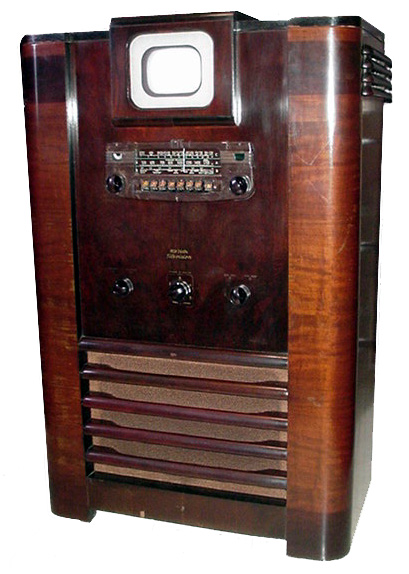 But is it possible? Sure, it's possible somebody watched Lucy first-run on a set identical to this one in the early 1950s. But it's more likely a collector watched a Lucy DVD on one in the early 2010s. 
|
|
|
|
|
02-29-2012, 05:43 PM
|
#9 |
|
Member
Senior Member
Join Date: Mar 29, 2006
Location: Long Branch, N.J.
Posts: 2,577
|
Television, at the time "I LOVE LUCY" began in 1951...
...was indeed somewhat "primitive", compared to these days.
There was no coaxial cable to provide "live" coast-to-coast telecasting until September of '51, over a month before Lucy went on the air. This is why sponsor Philip Morris initially insisted, after they "bought" the show in the spring of '51, that Lucy originate her show live from New York, because there was no way she could be seen "live" across the country- and they wanted their commercials to be seen clearly, instead of "muddy" kinescope film recordings that one side of the country {East/West, West/East} had to see on local stations, because the other end wasn't able to send a "live" picture cross-country. PM insisted that, since more smokers lived east of Chicago than west, Lucy HAD to stage her show from New York. She and Desi protested, and he suggested the show be filmed. That satisfied PM, as they had previously sponsored a filmed version of Ralph Edwards' "TRUTH OR CONSEQUENCES" radio show [on CBS] during the 1950-'51 season. In fact, the production supervisor, Al Simon, was hired by Desi to duplicate the method of filming their show before a live audience {via multiple film cameras and utilizing a "multiple" film editing device}. 
|
|
|
|
|
02-29-2012, 06:21 PM
|
#10 | |
|
anything good on?
Forum Regular
Join Date: Oct 18, 2005
Posts: 879
|
Quote:
|
|
|
|
|
|
03-01-2012, 07:58 PM
|
#11 |
|
Member
Senior Member
Join Date: Mar 29, 2006
Location: Long Branch, N.J.
Posts: 2,577
|
To give you a better idea of what the four broadcast networks were scheduling....
...on Monday nights in the fall of 1951, this was it [all times Eastern]:
7:00 CBS Local programming NBC "KUKLA, FRAN & OLLIE" (starring Fran Allison, and Burr Tillstrom's puppets) ABC "AFTER THE DEADLINES" (15 minute nightly newscast, followed by local programming) DuMont "CAPTAIN VIDEO AND HIS VIDEO RANGERS" 7:30 CBS "DOUGLAS EDWARDS WITH THE NEWS" NBC "MOHAWK SHOWROOM" (live musical interlude, featuring singer/pianist Roberta Quinlan) ABC "HOLLYWOOD SCREEN TEST" (live acting/talent competition, with Neil Hamilton, emcee) DuMONT Local programming 7:45 CBS "THE PERRY COMO SHOW" NBC "CAMEL NEWS CARAVAN" (John Cameron Swayze, anchorman) 8:00 CBS "LUX VIDEO THEATRE" (live adaptation of popular radio anthology) NBC "THE SPEIDEL SHOW" (live variety show starring Paul Winchell and his dummies, "Jerry Mahoney" and "Knucklehead Smiff") ABC "THE AMAZING MR. MALONE", alternating with "MR. DISTRICT ATTORNEY" (live adaptations of popular radio crime dramas) DuMONT "STAGE ENTRANCE" (show biz news and interviews, with NEW YORK POST columnist Earl Wilson) 8:30 CBS "ARTHUR GODFREY'S TALENT SCOUTS" (talent competition, simulcast on TV and radio) NBC "THE VOICE OF FIRESTONE" (simulcast of classical and semi-classical music, featuring guest performers, and Howard Barlow conducting the Firestone Concert Orchestra) ABC "LIFE BEGINS AT EIGHTY" (live panel show featuring "wisdom" dispensed by older celebrities, answering viewers' questions) DuMONT "THE JOHNS HOPKINS SCIENCE REVIEW" (current news, demonstrations, and innovations in the world of science, featuring members of Johns Hopkins University and their "special guests"- and THE lowest rated show of all the networks on Monday nights) 9:00 CBS "I LOVE LUCY" (you know) NBC "LIGHTS OUT" (live adaptation of popular radio science fiction/horror anthology, with Frank Gallop as "your {gruesome} host") ABC "CURTAIN UP" (old movies- and I do mean old {as in pre-1948}, mostly obscure, with some dating back to the start of the "talkie" era- edited to fit an hour-long time period) DuMONT "WRESTLING FROM COLUMBIA PARK" (the most popular wrestlers mixing it up at a New York arena for two hours, featuring Dennis James at ringside ["Okay, mother, that's a hammerlock..."]) 9:30 CBS "IT'S NEWS TO ME" (live current events quiz, featuring a celebrity panel, and John Daly {of "WHAT'S MY LINE?", on Sundays} as moderator) NBC "ROBERT MONTGOMERY PRESENTS 'YOUR LUCKY STRIKE THEATER'" (live dramatic anthology, hosted by veteran actor Robert Montgomery), alternating with "MUSICAL COMEDY TIME" (live hour-long adaptations of Broadway musical comedies, operettas, et. al.) 10:00 CBS "WESTINGHOUSE STUDIO ONE" (live dramatic anthology, featuring Betty Furness as the sponsor's spokeswoman in their commercials) ABC "THE BILL GWINN SHOW" (live game show involving three couples, and the songs that influenced their lives) 10:30 NBC "WHO SAID THAT?" (live literate panel show, with celebrities and other "notables" determining who spoke famous quotes, current and historic- with Walter Kiernan as moderator) ABC "STUDS' PLACE" (live informal variety show, with a wisp of a storyline, revolving around Studs Terkel's fictional restaurant in Chicago, where the series originated) Note that virtually the only network series produced and seen on film on Mondays that season....was Lucy's. Within five years, because of her popularity (and the realization that filmed programs were more profitable in the long run than "live" shows), most of the networks' Monday night programming were on film.
|
|
|
|
|
03-01-2012, 08:18 PM
|
#12 |
|
Member
Senior Member
Join Date: Mar 29, 2006
Location: Long Branch, N.J.
Posts: 2,577
|
There weren't as many stations...
...on the air as today, 'Yong'. For one thing, there was a "freeze" by the Federal Communications Commission on construction of new stations (and transmitters) from September 1948 through July 1952. As of the summer of 1951, there were 103 stations in 60 cities across the United States. The networks signed up as many of them as they could, but there were some locales where there was only ONE station in operation- like WMC, in Memphis, Tennessee. In that kind of situation, they often scheduled programming from at least two networks- or more- at the same time {primary, and a "secondary" affiliation}. In cases of "live" programming" shown on more than one network at the same time, the "secondary" network often sent 16mm "bicycle" film prints of "live" (and/or filmed) programs [kinescopes] for "delayed telecasting" at other hours.
|
|
|
|
|
09-07-2020, 09:06 AM
|
#13 |
|
Member
First Time Poster
Join Date: Aug 25, 2020
Location: USA, IL, Chicago
Posts: 1
|
how much television has changed since 1951... back then it used to be for people. now for business. and i find it sad. dbol results
|
|
Last edited by Haling49; 12-02-2020 at 03:01 PM. |
|
|
|
|
|
|
|